← All work

Case 01 of 05 · Self-initiated showcase · 3D Training Simulation with AI (Unity)

Warehouse Safety Training

Immersive 3D safety training with an AI instructor watching every move.

Warehouse Safety Training is a self-initiated showcase: an immersive 3D warehouse simulation built in Unity, where a trainee practises hazard response safely while an AI instructor watches what they do and corrects them in real time.

Year
2025
Type
Self-initiated showcase
Role
Design, 3D, AI integration, development
Built with
Unity, C#, Convai (conversational AI), 3D environment design
See it
Watch the demo ↗
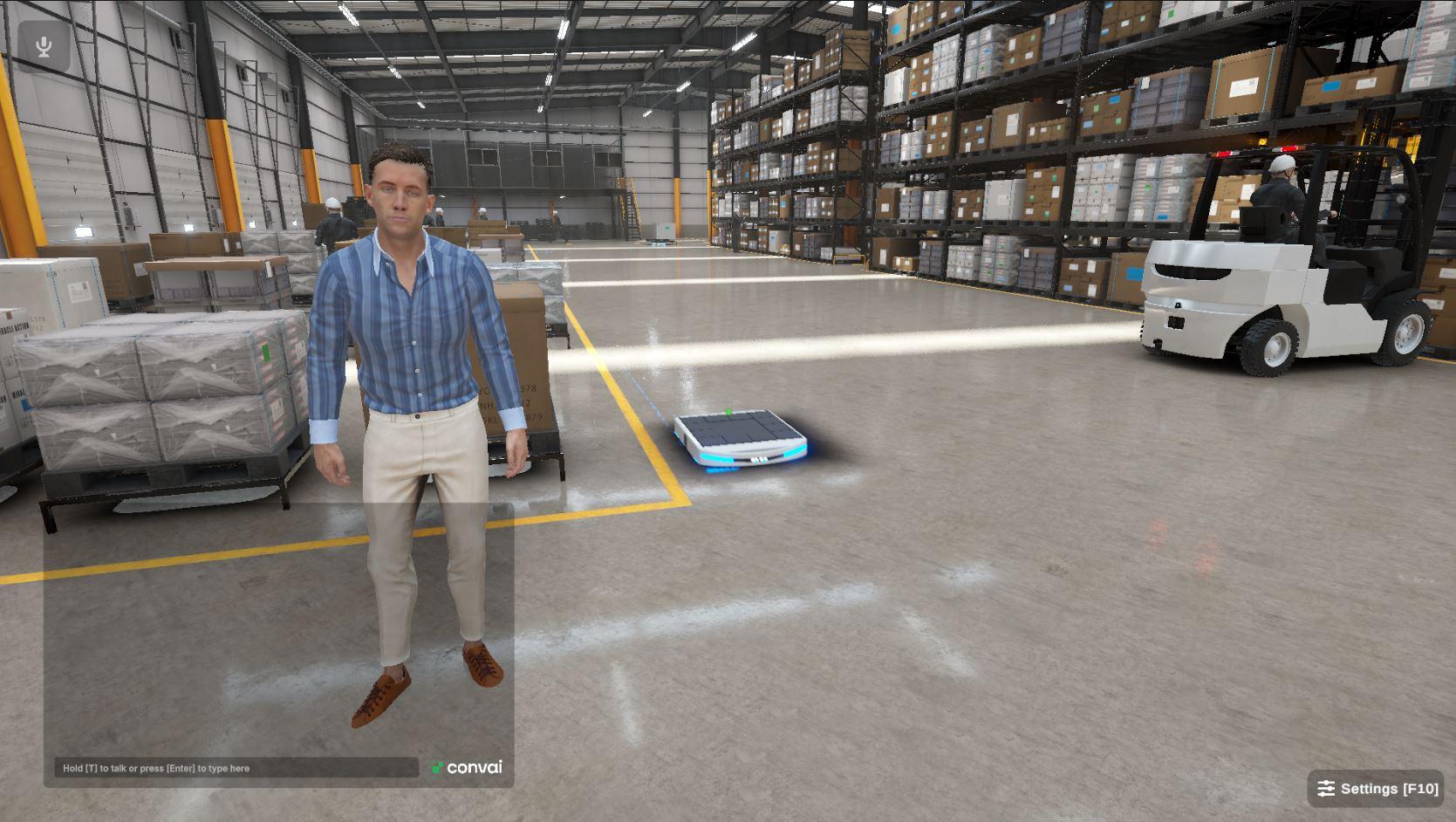
Warehouse Safety Training in Unity: an AI instructor stands on the warehouse floor, a forklift behind him and yellow safety markings on the ground.

Act 1 · Before

Training people for danger, without the danger

Warehouse accidents cluster around the exact situations you cannot rehearse on a live floor: forklift crossings, blocked escape routes, loads placed where they should never be. Classroom slides do not build reflexes.

The brief he set himself: a training environment that feels real enough to change behavior, is safe enough to fail in, and is repeatable enough to measure. The constraint: it had to run on the ordinary hardware a logistics company would already own.

  • Risk scenarios collected from real incident categories, not invented ones.
  • Repeatability chosen over spectacle: every scenario can be re-run and scored.

Act 2 · The work

How he built it

Structure

The scenario is the wireframe

Before any 3D, the training was designed as flows: walk a route, spot the hazard, respond, get corrected. Each scenario was mapped as a state machine of trainee decisions, wrong turns included, so the simulation always has an answer to what a person actually does.

The HUD was wireframed like a product, not a game: what the trainee must see at all times, what appears only on error, and what stays out of the way.

  • A hazard taxonomy became the backbone: every part of the scene belongs to a risk class.
  • Failure paths designed first; success is just the path with no corrections.
System

A visual language borrowed from the floor itself

The interface system reuses what warehouse workers already read fluently: floor markings, high-visibility signage, zone striping. Safety yellow is reserved for live danger and active guidance, so attention always means something.

Type in the HUD is terse and sized for peripheral reading while moving. Every label follows the same grammar: zone, state, action.

  • One accent color, mapped to danger and guidance only, never decoration.
  • HUD text tested at walking speed: if it needs a pause to read, it got shorter.
Craft

A warehouse built to feel worked-in

The 3D environment was modeled and lit to read as a real workplace: racking with inconsistent loads, wear on the floor paint, forklift routes that make operational sense. Hazard recognition only transfers if the scene looks like the trainee's actual world.

Movement, camera behavior and sound were tuned so the body believes the space: head height, walking pace, the audible approach of a forklift you cannot see yet.

  • Audio does safety work: engine sound direction is a training signal, not ambience.
  • Lighting kept physically plausible so shadows never hide a hazard unfairly.
Build

An AI instructor wired into the scene

Built in Unity with C#. Every scenario runs on the decision state machine from the structure phase; trainee position, gaze and actions stream into a telemetry layer. The instructor's voice and conversation run on Convai, a conversational AI platform for 3D characters, wired to that scene data.

The AI instructor consumes that telemetry live: it knows the trainee walked through an active forklift lane before a human observer would, and it phrases the correction in context. Sessions end with a generated report instead of a supervisor's memory.

  • AI feedback is grounded in scene telemetry, so corrections cite what actually happened.
  • Report format modelled on what a supervisor would actually file, not what looks impressive.

Same system, second world

Virtual Museum: the AI guide, applied to culture

The guide system from the warehouse was rebuilt for a different job: a walkable Unity museum of Ancient Greece and Rome, where a Convai-powered curator answers questions about whichever artifact the visitor is facing.

Same architecture, different domain. The guide receives the visitor's position and the exhibit in focus, and only answers from what it knows about each piece. A collection locked to one building becomes visitable from anywhere, at any hour.

Look closer

Click a number

A goes and stands on it, then explains the decision.

Warehouse Safety Training in Unity: an AI instructor stands on the warehouse floor, a forklift behind him and yellow safety markings on the ground.

Act 3 · After

A complete loop, safe to fail in

A working simulator that shows the idea end to end: a trainee rehearses forklift traffic, blocked routes and unsafe zones without any physical risk, and every session produces a readable report of what they saw, did and missed.

The showcase runs as a complete loop: brief, scenario, correction, report. It proves the untrainable can be rehearsed, and that a supervisor could get evidence instead of impressions.