CASE 02 · 3D · AI · UI · NARRATIVE
Virtual Museum
An AI-guided Unity museum you can walk through from anywhere.
- YEAR
- 2024
- ROLE
- Design, 3D, AI integration, development
- STACK
- Unity · C# · AI guide · 3D gallery design
BRIEF
A collection deserves more visitors than its building allows
Physical exhibitions have a hard ceiling: opening hours, geography, and floor space decide who gets to see the work. The brief was to remove that ceiling without flattening the experience into a scrolling image gallery.
The constraint that shaped everything: it had to feel like visiting, not browsing. Presence, pacing, and curiosity had to survive the transfer to a screen.
- N-01Anti-goal defined early: this must not become a carousel of JPEGs.
- N-02Consumer hardware target locked before art direction, not after.
STRUCTURE
Designing how a visitor wanders
Museum visits are not linear funnels, so the information architecture is spatial: galleries as rooms, sightlines as navigation, thresholds as chapter breaks. The visitor journey was mapped twice, once as free roam and once as a guided tour, and the build supports both.
Interaction was reduced to what a visitor already knows: walk, look, approach, ask.
- N-03Sightlines do the wayfinding: the next room is always visible before it is chosen.
- N-04Asking a question was made as cheap as looking: no menus between curiosity and answer.
SYSTEM
Exhibition design, ported honestly
The visual system borrows the discipline of physical exhibitions: label plates with consistent anatomy, restrained wall text, lighting that serves the artifact instead of the interface. UI appears near the work it describes, in the space, not pinned to the screen.
One warm light temperature holds the galleries together; accent light marks what is currently speaking to you.
- N-05Every exhibit label shares one anatomy: title, origin, one paragraph, one question prompt.
- N-06Interface lives in the scene as objects, keeping immersion unbroken.
CRAFT
Rooms tuned like film sets
Each gallery was built and lit in Unity as a composition: how a visitor enters, what they see first, where shadow makes them slow down. Camera movement is damped to a museum pace; footstep audio and room tone change per gallery.
Artifacts got individual presentation passes, pedestal height, orbit distance, light angle, the way a curator would place them.
- N-07Enter-composition checked per room: first sight is always a curated frame.
- N-08Movement damping tuned until visitors stopped rushing: pace is part of the design.
BUILD
A guide that knows what you are looking at
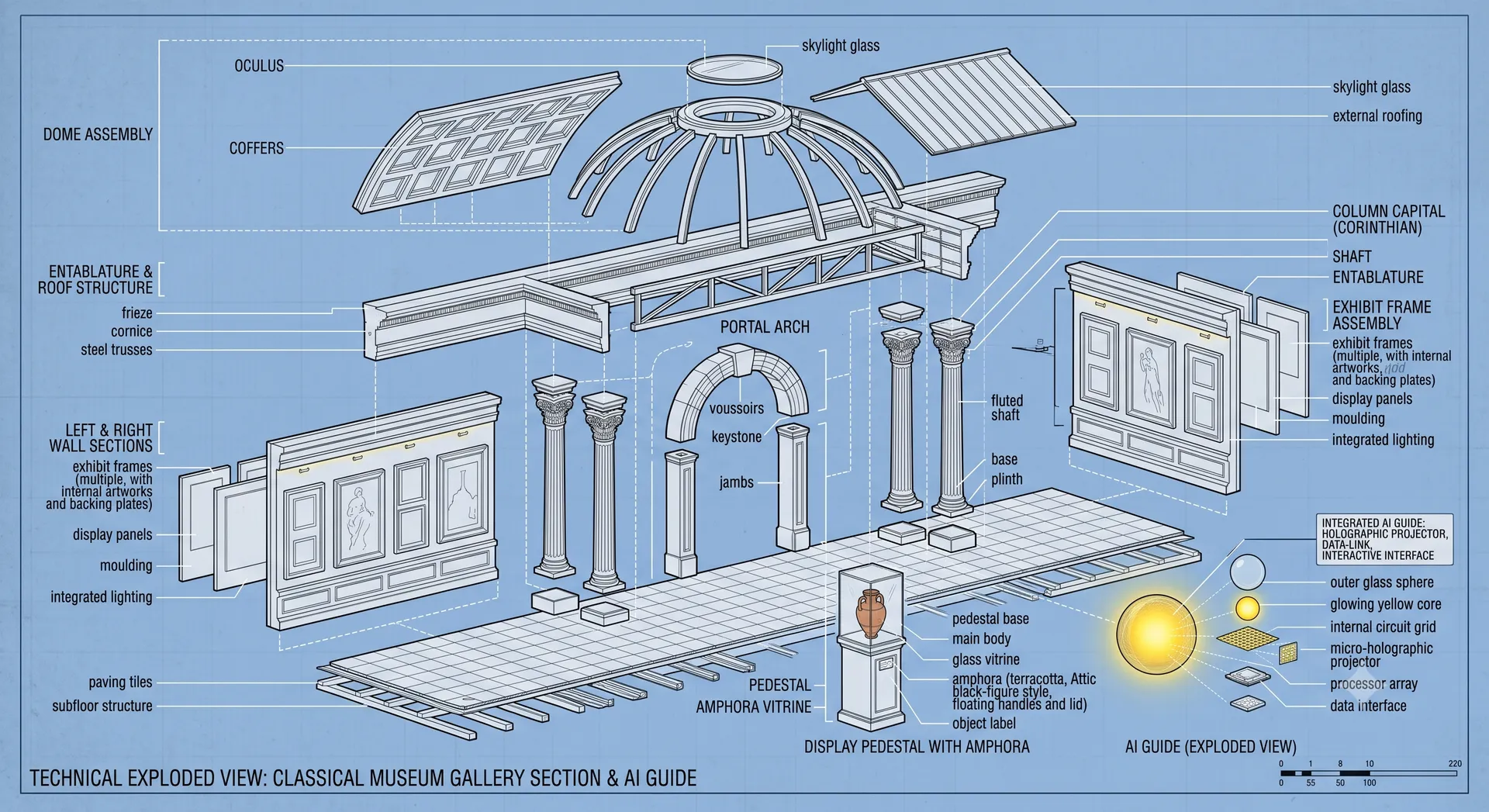
The AI guide is wired to the scene, not bolted on: it receives the visitor's position and the exhibit in focus, so a question like what is this gets answered about this. Exhibit knowledge is structured per artifact, and the guide stays inside it, no confident inventions.
Built in Unity with C#; the guide, navigation, and exhibit data run as separate systems so the collection can grow without rebuilding the museum.
- N-09Guide answers are grounded per artifact, scoped to curated knowledge.
- N-10Collection is data-driven: new exhibits are content, not code.
SHIPPED
Open every hour, everywhere
The museum ships as a walkable, askable place. Visitors wander at their own pace, and the guide turns every artifact into a conversation instead of a caption.
- N-11The assembled schematic above is the actual system map: space, artifact, guide, interface.
A collection that was locked to one physical place became visitable from anywhere, with a guide that never tires of questions. The AI answers in context, grounded in the exhibit the visitor is actually facing.
GALLERY
Virtual Museum, up close
NEXT · CASE 03
Taxino